From a factory production and manufacturing perspective, peeling and fading of press-on nails often involve raw material ratios, surface treatment processes, ink curing parameters, and quality control standards.Peeling, discoloration, yellowing, wear, and loss of shine in press on nails are mostly not “color problems,” but rather issues with the coating system. This article will answer long-standing user concerns from a press on nails manufacturer perspective.
Many buyers only look at color and style, but what truly determines quality are:
◎Base material (ABS/soft gel)
◎Base coat adhesion
◎Pigment stability
◎Top coat
◎UV curing process
Packaging and weather resistance. This is why some press on nails which look beautiful, peel after 3 days, while others look brand new after 2 weeks.
Ⅰ. Why does “peeling” occur?
① Substrate and Coating “Incompatibility”
This is the most common problem. Many low-cost press on nails patches use inexpensive ABS plastic, which has low surface energy and is difficult to bond. High-standard press on nails manufacturer will perform corona treatment to increase surface roughness; if this step is omitted, the adhesion will be significantly reduced. Low surface tension results in:
UV adhesive not holding the surface
Coating not truly adhering
Cracking upon bending
Peeling starting from the edges
A typical phenomenon is that the fingertips peel off first, the surface peels off in whole pieces like a film, and cracks spread after bending.
What do high-quality press on nails manufacturer do?
They typically:Perform surface buffing,Perform plasma treatment,Use an adhesion primer.
This allows the UV layer to truly “bite” into the nail plate.
② Incomplete UV Curing
Most press on nails patches are printed with UV inks. If the factory’s UV lamps are aging, have insufficient power, or the production line speed is too fast, the ink layer may only achieve a “surface dry,” while the interior remains in a semi-fluid state. When such patches are exposed to sunlight or everyday chemicals, the uncured monomer molecules undergo a secondary reaction, causing the color to bleach or darken rapidly.
Insufficient curing results in a seemingly dry surface, but the interior is not fully cross-linked, making it prone to:Blistering, Softening, Delamination, Top Coat peeling.
Dark colors, such as black, red, cat-eye, and glitter, are especially prone to incomplete curing.
③ Top Coat Too Brittle
The top coat is like a “bulletproof vest” protecting the color. If the spraying equipment is not precise enough, resulting in uneven thickness of the top coat, the weakest points will be worn down first, exposing the internal pigments to the air and causing oxidation. If the chemical polarity of the base color ink and the top coat material is incompatible, they will repel each other, causing the top coat to peel off like flaking skin, and the unprotected color will naturally fade.
Some glossy top coats have very high hardness but poor flexibility, resulting in cracking upon impact, with cracks spreading and eventually peeling off completely, especially on long-nailed coats like Coffin and Stiletto where bending stress is greater.
High-end brands usually balance hardness and flexibility, rather than simply pursuing “ultra-gloss.”
Ⅱ.Why does it “fading”?
① Insufficient UV Resistance of Pigments
When purchasing inks, factories classify pigments into different lightfastness grades (1-8). Low-cost factories may choose non-lightfast pigments with a grade of 3-4. These pigments have extremely unstable molecular structures under ultraviolet light and are highly susceptible to photodegradation.
The biggest problem with cheap pigments is their poor UV stability, resulting in:
- Yellowing after sunlight exposure
- Red turning orange
- Black turning gray
- Rapid fading of fluorescent colors
Neon colors, jelly colors, and those with Chrome effects are particularly prone to problems.
②Top Coat’s Resistance to Yellowing
Many inexpensive top coats are initially very shiny, but start to yellow after 1-2 weeks. This is usually because they use cheap resins, with insufficient light stabilizers and antioxidants. This is most noticeable on white-painted press-on nails, so high-end European and American brands pay special attention to:
. Non-yellowing top coat
. UV-resistant coating

Ⅲ. Why are cat-eye/mirror surfaces particularly prone to problems?
Cat-eye and mirror finishes represent the pinnacle of nail art aesthetics, but they are also the most prone to production failures in factories. From an industrial manufacturing perspective, their failures typically stem from the instability of magnetic field dynamics and the adhesion paradox of ultra-smooth surfaces.
The cat-eye effect is created by the directional alignment of metallic particles in the ink under the influence of a magnet. Magnetic powder has a much higher density than colloid. On automated coating lines in factories, if the ink is not mixed evenly, the magnetic powder will sink to the bottom. Some factories omit high-frequency mixing, or the UV curing lamp’s power is insufficient, causing magnetic powder displacement.
Symptoms: Within the same batch of press-on nails, some may have very bright cat-eye effects, while others may have barely visible halos, or the halos may appear as scattered spots.
The mirror finish is usually created by the physical adsorption of mirror powder (ultra-fine metallic powder) onto the top coat surface. If the factory omits the “reinforcing layer” process, or if the edges are not fully “sealed” during spraying, moisture and oxygen from the air will penetrate.
Phenomenon: The patches were initially shiny like a mirror, but after a few days of use, they turned gray, black, or even developed rust spots.
If the quality of these patches you purchased is inconsistent, it’s usually because the manufacturer compromised on precise control of curing time or multi-layer lamination processes to achieve efficiency. It is recommended to choose a press on manufacturer that explicitly state the use of “multi-layer gel processing.”
Ⅳ.To reduce peeling and fading, high-standardpress on nails manufacturertypically perform the following tests:
Cross-Cut Test: A grid is drawn on the patch surface with a blade, and standard tape is applied and then peeled off to test the adhesion level of the coating and top layer.
Artificial Sweat/Chemical Immersion Test: The patch is immersed in simulated sweat, alcohol, or detergent for 24-48 hours, and the color change or bubbling is observed.
UV Aging Test: The patch is continuously exposed to high-intensity ultraviolet light in a chamber, simulating months of sunlight exposure to verify color stability.
Hot and Cold Cycling Test: Simulates an environment from hot to cold water to test the stability of the patch and adhesive under thermal expansion and contraction.
Bending Test: This is especially necessary for long press-on nails.
If you find that a batch of patches frequently has problems, from the press on nails manufacturer perspective, the most likely culprit is incorrect UV curing parameter settings (leading to fading) or incomplete removal of injection molding release agent, causing peeling. This is usually the price paid for production lines compressing working hours in pursuit of output.
Ⅴ.What are European and American buyers most afraid of?
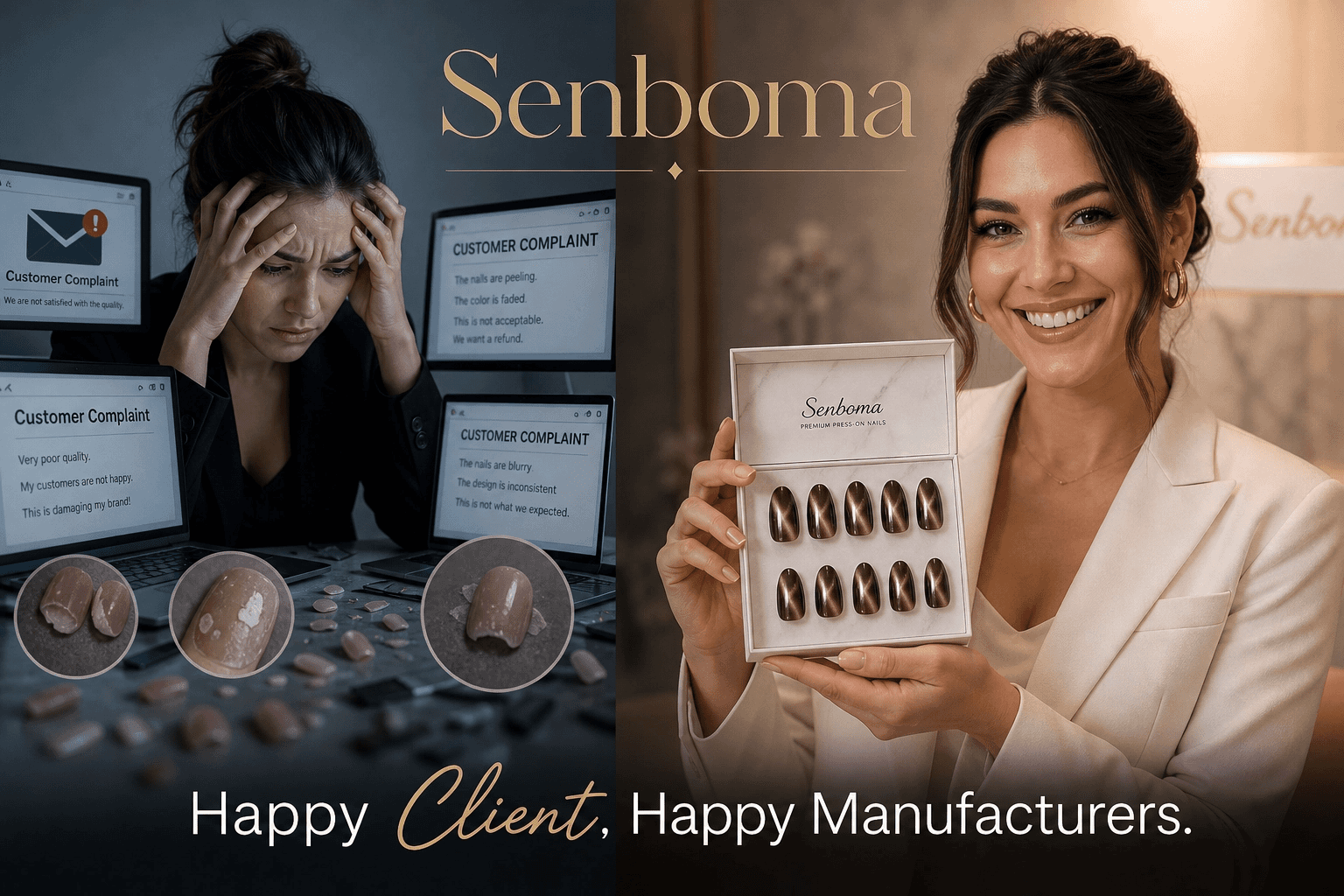
European and American brands are most afraid of samples looking great but the bulk production failing. This is because many press on nails manufacturer use imported adhesives for sampling, then switch to cheaper adhesives for mass production, resulting in paint peeling, customer complaints, plummeting ratings, and damage to brand trust.
Therefore, many mid-to-high-end buyers are now demanding:
Fixed raw material batches
COA/MSDS
Aging test reports
Production samples
Third-party testing
Ⅵ.What truly matters forpress onnailsbrands?
It’s not “whether they can make it look beautiful,” but rather “whether they can consistently replicate quality.”
Because after a hit product, order volumes surge, increasing production pressure. This is when issues like product shrinkage, material substitution, and shoddy workmanship become most likely to occur. For buyers or distributors, the fake nails supplier’s scale to handle large orders, maintain quality standards, and ensure proper quality control are crucial considerations.What brands or retailers fear most isn’t mediocrity but rather inconsistent quality—one batch good, another bad—leading to uncontrollable customer complaints. This directly damages repeat purchase rates and brand image.
VII. Why is a goodpress on nails manufacturer so important?
In the press-on nails industry, a “more expensive” factory is often not more expensive because of its higher profit margin, but rather because of its greater risk hedging and brand asset protection. For brands, choosing a good press on nails manufacturer saves not only trouble and time, but also real money.
In the press-on nails industry, “more expensive” factories are often not more expensive because of higher profits, but rather because of their enhanced risk hedging and brand asset protection. For brands, choosing a good factory saves not only time and hassle, but also real financial savings.

1.How much “hidden cost” can a good press on nails manufacturer save a brand?
| Cost dimension | Poor quality factory (low price) | Good factories (a bit more expensive) | What did the brand save? |
| After-sales return and exchange | Peeling and fading rates may be as high as 10%-15%. | The quality is stable, and the complaint rate is usually below 1%. | It saves on: round-trip shipping costs, customer service costs, and cargo damage. |
| Loss of repeat purchase rate | Consumers have a “one-time” experience and will not repurchase. | The wearing experience is good, leading to high repeat purchase rates. | It saves on: extremely high customer acquisition costs (traffic is becoming increasingly expensive). |
| Inventory risk | Large color differences and inaccurate dimensions between batches led to dead stock. | Digital color matching, with dimensional tolerance controlled within 0.05mm. | It saved on: tied-up capital and warehousing costs. |
| Compliance and Access | The pigments may contain excessive levels of heavy metals, posing a risk of being removed from shelves. | Provides SGS/MSDS certification and meets export standards. | This saves you from the risks of legal proceedings and platform account closure. |
2.The Ability to Protect “Brand Premium”
Press on nails has high profit margins, but this is contingent on consumers believing it’s “worth it.”
Products from poor factories have a plastic feel, rough edges, and scattered cat-eye halos. This reduces the brand to “cheap goods,” forcing it into price wars. Good factories can produce a gel look with rounded edges and a mirror-like finish that doesn’t oxidize. This quality, combined with Western aesthetics and packaging, allows the brand to sell at least 3-5 times the premium, far exceeding the few extra dollars the factory charges.
3.The “Moat” of R&D and Innovation
Good press on nails manufacturer have their own process labs. When you want to achieve a “translucent,” “aurora cat-eye,” or “3D embossed” finish, a good factory can help you achieve it by adjusting UV curing parameters and ink ratios, instead of telling you “it can’t be done.”
Poor press on nails manufacturer only imitate popular styles, lacking original process support, causing the brand to forever compete on price in a red ocean market.
4.Supply Chain Certainty
During holidays (such as Christmas and Black Friday), the production stability of reputable factories is the lifeline of a brand.
Reputable factories have strict SOPs (Standard Operating Procedures) and will not shorten UV curing time to rush production, ensuring that every box of product you send to consumers is of consistent quality.
There’s a saying in the nail industry: “The most expensive factory is often the cheapest one that generates a lot of returns and negative reviews.”
If your target market is $1 press on nails, requiring many orders to generate meager revenue: you can choose a low-priced press on nails manufacturer, but you’ll have to bear the high after-sales pressure.
If your target market is a brand, with a long-term focus: you must find a factory with cross-cut adhesion testing, aging tests, and precision injection molding capabilities.Finding a good press on nails manufacturer allows you to focus your energy on marketing and design, instead of dealing with trivial and potentially fatal quality complaints like “Why isn’t my cat-eye working?” or “Why did it fall off after two days?” The time and energy saved are the most valuable assets for a brand founder.
In the end, We cordially invite you to visit Senboma—China’s leading press on nails manufacturer. Explore our extensive OEM/ODM press-on nails product line and discover the infinite possibilities of beauty and innovation. Senboma collaborates with renowned international brands, including major retailers, primarily in Europe and America. Senboma understand their trends and popular styles. Let’s embark on this nail art journey together, experiencing the charm of nail art and showcasing your unique style and flair! Learn More about Senboma: https://www.youtube.com/watch?v=qqTPH5AxfdI