Industry Background: Supply Chain Challenges in the FMCG and Beauty Sector
The press on nails market has experienced explosive growth over the past three years. According to industry data, the global compound annual growth rate for artificial nails and nail tips remained above 18% between 2023 and 2025, with high-end press on nails products, emphasizing salon-like effects, showing particularly strong growth. However, behind this market boom lies a structural problem plaguing many emerging brands: rapid product design iterations coupled with inconsistent mass production quality; short market windows but severely lagging supply chain response.The quality of press on nails manufacturer varies greatly.
In this context, a miscalculated launch or quality control fluctuations often result in a season of inventory buildup and damaged channel trust. Brands are increasingly realizing that core competitiveness lies not only in aesthetically pleasing designs but also in finding a press on nails manufacturer partner who truly understands retail logic and can translate creative ideas into stable products.
What’s truly scarce isn’t creativity, but certainty—the ability of a qualify press on nails manufacturer to turn your good ideas into tangible products and keep them on store shelves at the right time.
Client Background: A brand that has lost trust in its supplier once.
The collaboration didn’t start smoothly.
The brand is an emerging high-end everyday beauty brand with a substantial following on social media and a stable distribution network across multiple offline retail channels. However, in the season prior to our contact, they experienced a rather frustrating collection launch: the design drafts received a warm reception, but the batch quality control at their partner press on nails manufacturer fluctuated significantly, with visibly noticeable differences in the curvature and color consistency of nail tips within the same batch, leading to a high return rate and negatively impacting the brand image.
Therefore, when they approached us with their new season’s concept sketches, they were exceptionally cautious. Their requirements were clear and demanding:
- The design must closely resemble the concept drawings, with minimal tolerance for error.
- Batch production consistency must be imperceptible to the naked eye.
- Extensive manual finishing touches cannot be used to compensate for manufacturing defects.
- Fixed timeline; no delays are permitted.
- All SKUs must be delivered within the same time window.
In other words, they are not looking for an ordinary press on nails manufacturer, but a partner who can proactively reduce uncertainty.
Our approach: disassemble first, then provide a quote.
Unlike most press on nails manufacturer that jump straight into the quotation process after receiving an inquiry, our first step is to break down the customer’s needs into three actionable dimensions and assess the risks associated with each:
Dimension 1: Design Feasibility Assessment
Upon receiving the concept drawings, our R&D engineers held two rounds of in-depth, focused meetings with the client’s design team. The focus wasn’t on evaluating the design’s aesthetics, but rather on verifying the feasibility of each design element in mass production processes—for example, how many processes are required for a gradient color scheme, the color difference tolerance for each process, and which details, while achievable in prototyping, might cause systemic deviations in mass production. The goal of this step is to eliminate the fundamental risk of a beautiful prototype failing in mass production before the sample stage.
Dimension 2: Process Stability Solution Design
We proactively suggested to the client regarding their core process selection: replacing some of the original surface coating solutions with two-shot injection molding. This decision is based on clear engineering logic—traditional surface coating processes rely heavily on manual operations, and color uniformity is significantly affected by environmental humidity and operating techniques, with batch-to-batch color differences being a major industry pain point; while two-shot injection molding combines two colors/materials at the mold stage, fundamentally eliminating the consistency variables introduced by manual coating.

Dimension3: Mass Production Consistency Control System
Before officially entering the prototyping stage, we collaborated with the client to develop a set of mass production control standard documents, including: the radius tolerance range of the lens flare (±0.15mm), color value standards (dual anchoring using Pantone numbers and physical color swatches), surface gloss grading standards, and the minimum acceptance threshold for the integrity rate of the final packaging. This document served as the sole technical benchmark throughout the entire project cycle, avoiding cognitive disagreements caused by ambiguous standards.
Prototyping stage: Two rounds of rejection, resulting in a marketable product.
The first sample failed internal review. Strictly speaking, the process itself was not problematic—the curvature and fit of the nail plate, and the color separation accuracy of the two-color injection molding, all met technical standards. However, when the sample was placed in a simulated shelf environment, we discovered a more fundamental problem:
Prototyping stage: Two rounds of rejection, resulting in a marketable product.
The first sample failed internal review. Strictly speaking, the process itself was not problematic—the curvature and fit of the nail plate, and the color separation accuracy of the two-color injection molding, all met technical standards. However, when the sample was placed in a simulated shelf environment, we discovered a more fundamental problem:
| Iteration rounds | Main adjustment direction | Key conclusions |
| Round 1 | Process replication and technology verification | The process meets the standards, but the shelf adaptability is insufficient. |
| Round 2 | Color, proportion, and visual density optimization | Shelf testing passed, ready for mass production. |
| Round 3 (partial) | Minor adjustments to ensure visual consistency | Overall visual consistency confirmed |
Detailed Process Explanation: How Two-Color Injection Molding Solves Consistency Issues
For B2B procurement decision-makers, understanding the logic behind process selection helps in more accurately assessing the technical capabilities of suppliers. The following is a brief description of the core processes used in this project.
What is two-shot injection molding?
Two-color injection molding is a process that completes the injection molding of two materials or two colors in a single mold cycle. Unlike the traditional approach of “painting after molding”, the combination of the two colors in two-color injection molding occurs inside the mold: after the first material is injected and cooled, the mold rotates, and the second material is injected at a precise location, forming a bonding interface at the molecular level.
Advantages compared to traditional painting processes
- Color Consistency: Eliminates operational differences caused by manual spraying/spot coating; batch color difference is controlled within the standard range of ΔE < 1.5.
- Durability: The color of two-color injection molding is the material’s inherent color, eliminating the risk of surface coating peeling. It has passed 10,000 friction cycles.
- Yield Rate: The yield rate during mass production remains stable above 97.8%, approximately 12 percentage points higher than the average level of traditional processes.
- Labor Dependence: Manual intervention points in related processes are reduced by approximately 60%, significantly improving production cycle predictability.
Mold precision requirements
Two-color injection molding demands significantly higher precision in mold manufacturing than single-color injection molding. In this project, the cavity dimensional tolerance of the mold was controlled within ±0.05mm, and the repeatability of the rotary table was within ±0.02mm. This level of precision directly determines the clarity and consistency of the two-color dividing line, and is a prerequisite for achieving high-fidelity design reproduction in wearable nail products.
Quality Control: From Single-Point Inspection to a Full-Process Quality System
At Senboma, quality control is not a sampling inspection procedure at the end of production, but a systematic effort that runs through the entire process from raw material warehousing to finished product shipment. For this project, we implemented the following key control points:
Raw Material Control
All injection molding raw materials undergo batch color value testing upon arrival (standard: color difference ΔE < 0.8 from the reference color swatch). Unqualified batches are returned to the supplier and do not enter the production process.
First Article Inspection (ISIR)
Each SKU undergoes an Initial Sample Inspection Report before mass production begins. Mass production is only permitted after all 10 key parameters, including dimensions, color, and curvature, meet the standards.
In-Process Quality Control (IPQC)
Online sampling inspection is conducted every 2 hours during production. 30 pieces are randomly selected each time to test three core indicators: curvature tolerance, color difference, and surface defects (bubbles, shrinkage marks, flash). If any indicator exceeds the control line twice consecutively, a production stoppage and re-inspection process is immediately triggered.
Finished Product Outgoing Quality Control (OQC)
As a professional press on nails manufacturer, All batches of finished products undergo outgoing inspection according to AQL 1.5 standards. Inspection items cover 5 major categories and 22 sub-items, including appearance, dimensions, curvature, color, and packaging integrity. The first-pass yield of the final shipment batch of this project was 100%.
| Inspection Node | Frequency | Key Indicators |
| Raw material warehousing | Each batch | Color differenceΔE<0.8 |
| First item confirmed | Before mass production of each SKU | All 10 parameters met the standards |
| Process sampling inspection | Every 2 hours | Curvature/Color difference/Surface defects |
| Outgoing Inspection(OQC) | All batches AQL 1.5 | 5 categories, 22 items, 100% pass rate. |
Packaging Design: Enabling Last-Mile Conversion on the Shelf:
Many press on nails manufacturer have overlooked the fact that: The packaging design of press on nail products is essentially a “silent salesperson” at the retail terminal. In a shelf setting without sales staff, the packaging needs to convey brand positioning, showcase product selling points, and trigger purchase desire within 3 seconds. Based on this logic, we collaborated deeply with the client’s design team on the packaging solution:
Transparent Display Window Design:
A full-length transparent PVC display window showcases the complete arrangement of all 28 nail pieces. Consumers can directly assess the product’s color effect and model completeness without opening the packaging, significantly reducing purchase hesitation caused by “not being able to see the product.”
Shelf Hanging and Display Compatibility Design:
The packaging back panel has pre-drilled Euroslot holes, compatible with both hook and flat display shelf formats, adapting to the display needs of different channels and avoiding additional customization costs due to channel differences.
Information Hierarchy Design:
The front of the packaging follows the “3-second information delivery” principle: the main visual (product display) occupies 60% of the area, the brand logo and series name occupy 25%, and the core selling points are limited to no more than 12 characters. Avoid information overload and ensure a clear visual focus.

Environmentally friendly materials are used:
The outer packaging cardboard is made of FSC-certified recycled paper, and the inner lining uses biodegradable materials, aligning with the brand’s sustainable positioning and meeting the environmental packaging compliance requirements of some EU sales channels.
Project Delivery: Cycle, Scale, and Results
The following are the key delivery data for this collaboration:
| Project Indicators | Data | Remark |
| Number of SKUs in the Series | Six | Covering French, gradient, and solid colors |
| From prototyping to mass production confirmation | 23 days | Includes 3 rounds of iteration |
| Initial production scale | 80,000 sets | Includes full packaging |
| Mass production yield | 97.8% | About 12% points higher than the industry average |
| OQC first pass rate | 100% | According to AQL 1.5 standard |
| On-time delivery rate | 100% | Complete before the agreed listing window period |
The series entered the top 3 in sales across all channels within its first month of launch. In the eight weeks following its launch, its organic search ranking on major e-commerce platforms continued to improve, and offline retail restocking frequency reached 2.3 times that of other series during the same period. More importantly, this series became one of the brand’s highest-repurchase-rate series in the subsequent two seasons, validating the long-term impact of product quality on customer retention.The customer is very satisfied with Senboma press on nails manufacturer.
Reusable Methodology: As a Press On Nails Manufacturer, How We Systematically Reduce Uncertainty
This project was more than just a successful delivery case for us; it was a validation of a methodology. In the fast-paced retail market, the core challenge brands face is uncertainty—uncertainty about whether the design can be implemented, uncertainty about quality stability, and uncertainty about delivery time.
Our approach to these three types of uncertainty can be summarized in the following framework:
- Design uncertainty: Eliminated through upstream intervention (process feasibility assessment before prototyping) and iterative mechanisms (small-batch, multi-round verification).
- Quality uncertainty: Managed through process standardization (reducing human intervention points) and a full-process quality control system (not relying on end-point sampling).
- Delivery time uncertainty: Guaranteed through pre-emptive capacity locking and phased milestone management.
This framework is not only applicable to press on nails products but also to any beauty and consumer goods manufacturing scenario with strict requirements for consistency and delivery time.
After the project was completed, the client team leader said, “This time we finally don’t have to worry about the production side anymore.” This was one of the results we valued most.
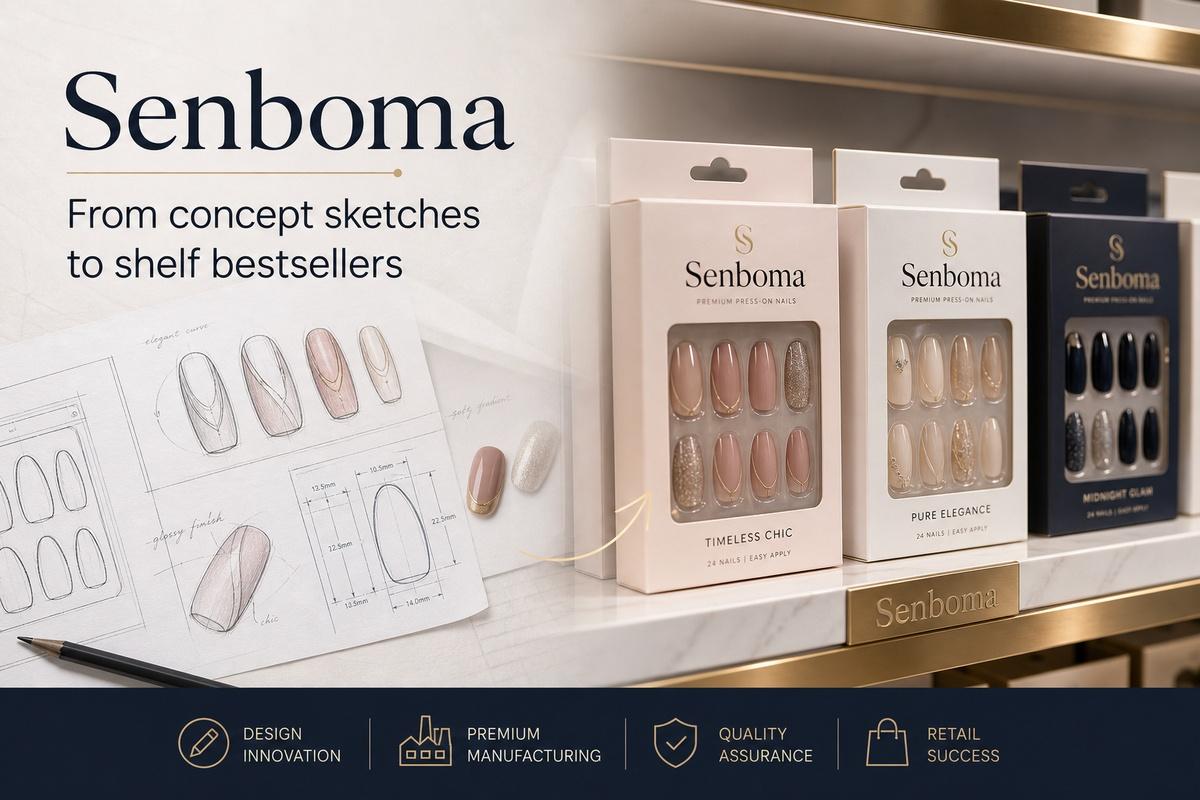
In conclusion, from concept drawings to shelf success, Senboma’s collaboration with this brand client reaffirms a key observation: in the fiercely competitive beauty retail market, a product’s success is never a victory of a single element, but rather a systematic result of collaborative capabilities across design, craftsmanship, quality control, and supply chain.
As a professional press on nails manufacturer, we understand our brand clients’ core needs when facing the supply chain—not just “being able to do it,” but “doing it steadily, accurately, and quickly.” This is the fundamental driving force behind our continuous investment in technological research and development and process system construction.
If you are looking for a press on nails manufacturer partner who can systematically reduce uncertainty for your next season’s new products, we are willing to collaborate with you in the same way.