By 2026, is the press-on nail industry still profitable? And what are the trends in Europe, North America, and the Japan–Korea beauty markets? This article will answer everything step by step.
To summarize first: in 2026, “Private label press-on nails” not only still have a market, but are continuing to grow. Let’s look at some real market data.
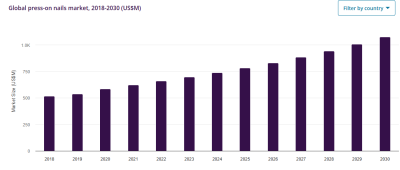
The global press-on nail market is approximately USD 753 million in 2026, and is expected to surpass USD 1.075 billion by 2030, with a CAGR of around 6.5%. This indicates it is a steadily growing consumer category, not a declining market.
Looking at a broader scope, the global false nails market (including salon nails + press-on nails) was about USD 5.2 billion in 2025 and is expected to reach USD 8.7 billion by 2034. Press-on nails are only a sub-segment of this market, but their growth rate is higher than traditional nail services.
The United States is the market with the highest level of “brand development” in press-on nails globally.
In 2026, the market share distribution is roughly:
♥North America: 35%
♥Europe: 27%
♥Asia-Pacific: 34%
North America: the largest market, driven by TikTok-fueled instant consumption culture.
The United States dominates the North American market with about 85% share. In 2026, the market size is estimated at USD 560 million. The region is supported by a strong professional nail salon system, a highly social-media-driven nail art culture, and leading brands such as KISS and OPI.
Sales of artificial nail products in the U.S. grew at a CAGR of approximately 9.4% from 2019 to 2025, significantly outpacing offline channels. The rise of DTC (direct-to-consumer) models has reduced distribution friction, while TikTok Shop and Instagram Shopping have further accelerated this trend. Consumers are highly driven by “instant gratification” and frequent nail style changes.
North America is one of the largest press-on nail markets in the world. Consumer behavior is characterized by a strong preference for convenience and speed. Users like salon-quality results but do not want to spend time in salons. The middle-class population is large, and consumers are willing to accept higher price points as long as quality is consistent.
Main price segments include:
USD 10–20 (mass market)
USD 20–40 (mid-to-high end)
USD 40+ (designer brands)
Popular styles include: Glazed Donut Nails,French Tips,Nude & Minimalist,Chrome Nails,Cat Eye Nails,Coquette Style (bow-themed designs).
The main trends in North America are: short nails growing faster than long nails, increasing demand for DIY kits, and rising demand for custom designs.
Europe: refined and fashion-forward, with rising demand for customization.
The main markets include the United Kingdom, Germany, and France. Compared to other regions, Europe places greater emphasis on design aesthetics, brand storytelling, and sustainability rather than low price alone.
In 2025, the European market accounted for about 26.93% of the global artificial nail industry, approximately USD 480 million. It is expected to reach around USD 500 million in 2026. This growth is driven by an increasing number of professional nail salons and rising consumer willingness to pay for high-quality products.
Demand for customized designs and resin-based materials is clearly increasing, aligning with the broader trend of integration within the beauty and personal care industry.
The dominant style in Europe is the “Clean Look” aesthetic, focused on minimalism, with nude and earth-tone palettes. Consumers are more willing to pay a premium for high-quality, European-made products. However, high labor and rental costs also limit the pace of salon expansion.
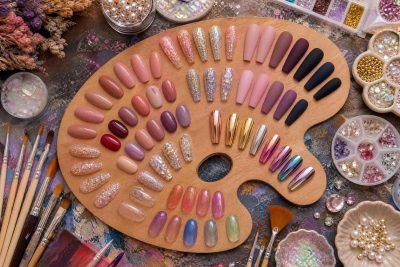
In the UK, popular styles include French nails, chrome designs, and luxury nude tones. TikTok has been one of the strongest influences driving trends in this market.
Germany’s popular styles include Natural Nails, Nude tones, and practical styles. German consumers tend to prefer highly functional products, such as reusable press-on nails that can be worn in multiple cycles. In terms of design, they generally avoid overly complex or decorative styles.
In France, the most popular styles include elevated French tips, subtle shimmer designs, and Morandi color palettes. French consumers place strong emphasis on aesthetics, which is also why many luxury brands originate from France. Luxury press-on nails are a growing trend, with rapid expansion in this segment. Consumers are willing to pay EUR 20–50 for a box of high-quality press-on nails.
Sustainability has also become a key purchasing criterion, including FSC-certified packaging, PCR materials, and plastic reduction initiatives.
For entering the European press-on nail market, it is essential to pay close attention to REACH regulations, product testing reports, and packaging compliance. Products should emphasize safety, non-toxicity, reusability, non-irritating adhesives, and low allergy risk.
Australia: smaller in scale but faster growth than the global average
The Australian press-on nail market was valued at USD 14.5 million in 2024 and is expected to reach USD 21.6 million by 2030, with a CAGR of 6.9%, higher than the global average.
Plastic materials currently dominate, but gel-based materials are the fastest-growing segment. Mid-to-high price ranges sell better, while the premium segment is expanding—especially custom and handmade designs.
The market shows a strong multicultural influence: Asian consumers bring in K-beauty aesthetics, while local consumers prefer natural tones and press-on nail styles suited to outdoor lifestyles.
The Australian market is strongly influenced by the United States. Consumer preferences lean toward natural looks, with less interest in overly dramatic designs. Minimalist trends continue to grow, and consumers increasingly prefer low-saturation colors, nude pinks, and semi-transparent jelly finishes.
Environmental awareness is also strong, with consumers paying attention to recyclable packaging, vegan products, and cruelty-free claims.
Popular styles include: Clean Girl Aesthetic, Milky White, Soft French, Nude Pink, and Short Almond.
Korea: a core driver of global trend export
Search volume for 3D nail stickers and decorative nail accessories increased by about 19% month-on-month in April 2026. In Seoul, the key trending styles in 2026 include aura gradient effects, gemstone layering designs, tortoiseshell patterns, and translucent chocolate nude layering. All of these trends move toward a “high-end jewelry aesthetic” and “wearable art” direction.
Korea is one of the main origin points of global press-on nail trends. Western markets typically adopt similar styles with a lag of 6–18 months.
Currently, Korea is one of the global trendsetters in press-on nail design. The dominant style is K-Beauty Nails, characterized by transparency, jelly-like finishes, and glossy “water-light” effects.
Popular decorative elements often include ribbons, pearls, 3D floral designs, water-drop gel, and aurora effects. Demand for 3D sculpted designs continues to grow. Korean consumers prefer handmade aesthetics, artistic expression, and highly detailed nail designs.
Short nails continue to gain popularity, with Short Oval and Short Almond shapes becoming increasingly mainstream.
Competition in the Korean market is extremely intense. Consumers rely heavily on the aesthetic judgment of designers, making it difficult for foreign brands to enter mainstream channels. Because design evolves so quickly, Korean consumers place more trust in individual designers rather than brands themselves. As a result, many “press-on nail brands” are actually personal IPs of nail artists, small studios, or designer collectives.
The core logic of the Korean market can be summarized as: “Who designs it sells it, not who has the biggest brand.”
Japan: a benchmark of precision craftsmanship with a strong focus on nail health
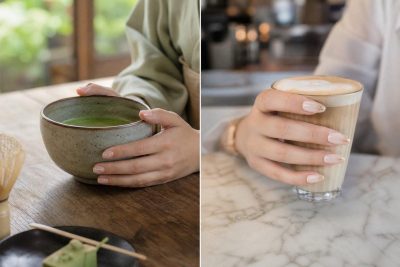
The Japanese press-on nail market is defined by the integration of traditional craftsmanship and modern innovation. Key features include soft gel applications (lasting 4–5 weeks without damaging the nail surface), dominance of macaroon and soft pastel color palettes, and cultural fusion designs combining traditional motifs like cherry blossoms with chrome effects and asymmetrical styles.
Cat-eye nails have been popular in Japan for around a decade. In 2026, new velvet-texture variations are giving this style renewed popularity, and it is expected to remain trendy. Nail artists note that Japan is “far ahead” in technical innovation, with events like Tokyo Nail Expo continuously introducing new global techniques.
The Japanese market is very different from Korea. Its popular styles are distinctly “Japanese nails,” characterized by elegance, softness, and subtlety rather than bold or exaggerated designs.
Consumers place extremely high importance on quality, packaging, and fine details, and are willing to pay premium prices. Collaborations with anime IPs are very common, with idol culture, anime, and gaming driving significant sales.
Japanese clients typically demand strict quality control, stable lead times, and refined packaging. Japan is a highly stable and aesthetically consistent “refined market,” and, similar to Korea, it is difficult for foreign brands to become mainstream.
South Korea and Japan are at the forefront of this trend, North America is the largest market in terms of volume, Europe needs to adapt to localized sophistication, and Australia is an emerging market with rapidly increasing penetration of gel materials.
From a market trend perspective, while North America, Australia, Europe, South Korea, and Japan are all experiencing growth, their popular styles, consumer demands, purchasing channels, and brand strategies differ significantly.
KR vsJP vsUS/EU
| Dimension | South Korea | Japan | US/EU |
| Market-driven | Designer/Salon | Retail Brands | Independent Brands |
| Domestic Brands Percentage | High(~80%) | Very high(~85–90%) | Middle(~50–60%) |
| Opportunities for foreign brands | Middle(Design Collaboration) | Low(Channel barriers) | High(DTC/Private Label) |
| Core Competitiveness | Design speed | Refinement and Stability | Marketing + Brand |
China is the most unique player in the global press-on nail market—it is both the world’s largest manufacturing and export base, and also one of the fastest-growing consumer markets. The combination of these two roles places China in an irreplaceable position within the global supply chain.
The total market size is approximately USD 3 billion, including both domestic consumption and exports. Guangzhou serves as a major OEM and private-label manufacturing hub, while Shenzhen forms a dual-center system of “design + manufacturing.”
Unlike other countries that are purely consumer markets, China is also a core global supplier of press-on nails. There is a small city with a population of around one million people where, in 2024, annual press-on nail sales reached 150 million sets, generating over RMB 8 billion in revenue. Of this, 80 million sets were exported through cross-border e-commerce to 35 countries and regions, making it one of the most iconic “Made in China goes global” product categories.
By 2028, China’s press-on nail market is expected to grow from approximately RMB 9.2 billion to RMB 64 billion, with a compound annual growth rate of about 62%. This growth rate is fundamentally different from the ~6% CAGR seen in Europe and the US. China’s growth comes from rapid expansion starting from a low base, while Western markets represent mature, stable growth.
The “substitution economy” is reshaping consumer behavior. In February 2025, the topic “substitute for premium brands” on Xiaohongshu reached 1.59 billion views, while “luxury dupes” reached 580 million views. Press-on nails fit this trend perfectly—offering salon-like results at roughly one-tenth the price, satisfying both beauty needs and rational consumption psychology.
Handmade press-on nails have evolved from niche offline markets into large-scale online sales, driven by advantages such as health safety, environmental friendliness, diverse designs, and convenience. The industry now operates under a dual-track model: “designer-led originals” and “industrial cluster OEM manufacturing.”
In China, press-on nails are not just a consumer product—they are also a side business for many young people. Individuals design and sell their own products, creating an ecosystem where “consumer, creator, and seller are the same person,” a scale of which is rarely seen in other markets.
If you are building a private label press-on nail brand, the suitability of different markets varies significantly. The key is not “which market is the largest,” but rather: where it is easier to achieve brand growth, repeat purchases, and a healthy profit structure.
Tier One
United States (Primary Market ⭐⭐⭐⭐⭐)
Why it is the most suitable market for building a private label brand:
1.Largest scale + highest maturity
Press-on nails are already a fully mature consumer category in the U.S. User education is complete—there is no need to explain what they are.
2.Complete DTC + TikTok ecosystem
A fully developed e-commerce environment:
TikTok Shop drives viral, trend-based sales;
Shopify independent stores focus on brand building and retention;
Amazon provides stable baseline sales.
3.Very high aesthetic acceptance
Long styles, glamorous designs, bling, 3D nail art—all sell well. Different aesthetics all have distinct audience segments.
4.Strong repeat purchase behavior
One customer may buy 10–30 different sets for rotation and frequent style changes.
Overall, the U.S. is the best market for building a brand from zero and scaling it into a breakout product.
United Kingdom (Second Recommendation ⭐⭐⭐⭐)
The UK is one of the best English-speaking press-on nails markets to replicate the U.S. model.
Its advantage lies in a unified language system, meaning no additional localization content overhaul is needed. At the same time, the beauty market is stable (£26.8B) with high e-commerce penetration.
Within the niche, the UK press-on nails market is growing at approximately 6.7% CAGR, shifting from traditional salon services toward “at-home DIY + semi-professional products.”
In terms of consumer structure, UK users tend to prefer stable aesthetic styles such as “clean / nude / French / natural almond.” This makes it easier for brands to build a consistent visual identity and long-term SKU system.
On the channel side, TikTok has become a key traffic driver, while Amazon UK accounts for about 22% of the beauty e-commerce market—making it a mature “TikTok seeding + Amazon conversion” ecosystem.
Overall, the UK is more suitable as a “high-conversion English market replication hub.” Compared to the U.S., it is easier to maintain brand consistency, but the total market size is smaller.
Australia (Third Recommendation ⭐⭐⭐⭐)
Small population but high purchasing power. Higher average order value is achievable. Competition is lower than in the U.S., and the market relies heavily on imports from Europe, the U.S., and Asia—meaning many Western product models can be directly replicated.
The aesthetic preference leans toward natural and minimal styles. Nude, French, and almond shapes sell particularly well.
Australia is a “small but premium” market, well-suited for high-margin brands rather than low-price volume strategies. Consumers are willing to pay for “design + texture + reusability,” making it more suitable for a brand-driven, profit-focused product strategy.
Tier Two
Germany / France / Italy / Spain (Core Europe)
Advantages is:Large market size (core consumer regions in Europe);Mature beauty consumption market and Strong Amazon EU ecosystem
However, key challenges include high compliance costs; higher launch cost compared to the U.S and highly fragmented aesthetic preferences:
Germany: rational, minimalistic style
France: fashion-forward and trend-driven
Italy: more stylistic and expressive aesthetics
Spain: price-sensitive market
In addition, Europe is highly multilingual, increasing operational complexity.
Although Europe as a whole is more suitable as a market for established brand expansion, this does not mean it is unsuitable for a 0–1 startup launch. For those who are truly deeply rooted in the country or are local entrepreneurs, if they have a strong understanding of local aesthetics and already possess local distribution channels (which is a major advantage), Europe can actually be a market with lower competitive intensity than the United States, while offering more stable brand premium potential—making it well worth serious exploration.
Low Priority Markets (Not recommended as primary launch markets)
Canada
The Canadian market is relatively small and highly correlated with the U.S. market. It can be treated as an extension of the U.S. strategy rather than an independent core market. In practice, the U.S. should be the main launch market, with Canada serving as a secondary expansion region.
South Korea
The Korean market is dominated by local nail salons and gel nail systems. Nail consumption is highly dependent on offline salon services. Gel nails occupy the mainstream position, while press-on nails are still a supplementary category used mainly for temporary styling, photography, or short-term wear. Overall acceptance remains limited.
Japan
Japan presents a distinctly different structure, with strong preference for ultra-refined, short-length, clean and natural aesthetics. Japanese nail culture emphasizes low visibility but high precision, and therefore relies heavily on professional salon-designed short gel nail styles.
From a global press-on nails expansion perspective, both Japan and Korea are mature beauty markets but are structurally salon-dependent systems, where e-commerce-driven growth is limited.
Therefore, while demand does exist in Japan and Korea, their consumption structure positions them as salon-led mature markets, where press-on nails remain a supplementary category rather than a primary growth driver. As a result, they are not considered core incremental markets for global press-on nail expansion at this stage.
The Canadian market is relatively small and highly integrated with the U.S. market. It can be developed as an extension of the U.S. strategy, rather than an independent core market. In practice, the U.S. should remain the primary battlefield, while Canada serves as a supplementary, spillover market.
The South Korean market is dominated by local nail salon systems and gel nails. Nail consumption is highly dependent on offline salons, with gel nails holding the mainstream position. Press-on nails still mainly serve as a supplementary category for temporary styling, photoshoots, or short-term use, and overall consumer acceptance remains limited.
The Japanese market shows a clearly different structure, with strong preference for extremely refined, short-length, clean, and natural aesthetics. Japanese nail culture has long been centered on low visibility but high finish quality, which makes it heavily reliant on professional salon-designed short gel nail styles.
From a global expansion perspective for press-on nails, both Japan and Korea are mature beauty markets, but they are structurally salon-dependent systems where e-commerce-driven growth is limited.
This does not mean there is no demand in these markets. Rather, their consumption structure makes them “salon-led mature markets,” where press-on nails remain a supplementary category. As a result, they are not considered core incremental growth markets for the global press-on nail industry at this stage.
In 2026, if you plan to build a private label press-on nail brand, here are some friendly recommendations.
Press-on nails are not a “pure branding industry” — they are a combination of three core capabilities:
1.Product capability (designs + craftsmanship + fit/comfort)
2.Supply chain capability (stable mass production + fast new product launches)
3.Traffic / channel capability (TikTok / Amazon )
(1) Don’t start with “branding” — start with a “product line”
In the early stage, you should only focus on:
* 20–40 design styles
* 3 shapes (Almond / Coffin / Square)
* 2 lengths (Short / Medium)
* Fewer SKUs, faster market validation
(2) Choose a clear style direction — don’t try to do everything
Avoid making “everything looks good.” Instead, choose a mainstream Western niche, such as:
♠Clean Girl aesthetic (clean, minimal, natural)
♠Upgraded French Tip styles
♠Glazed Donut nails
♠Minimal Luxury style
♠ TikTok-driven viral categories:
♠High-visual-impact styles (bling / 3D / chrome)
♠Seasonal & holiday themes
♠Emotional/aesthetic designs (love / aesthetic storytelling styles)
(3) Lock in your supply chain (this is the most critical part)
You must confirm whether your factory supports:
OEM / Private Label services
MOQ requirements
Fast sampling (7–10 days)
Packaging customization (logo boxes, branded packaging)
If your supply chain is unstable, everything later will fail.
(4) Don’t produce before testing the market
Your personal taste is not equal to market demand.
The correct approach is to use advertising and market data to guide design decisions — especially for premium nail products.

Senboma provides an all-in-one solution!
Senboma is not only a press-on nails manufacturing factory, but also a launch partner for new press-on nails brands. We understand that for startup clients entering the press-on nails market, the biggest challenges are not production capacity, but rather how to select products, how to build a brand, and how to achieve sales conversion.
Therefore, Senboma provides 3–5 complete, ready-to-launch collection solutions, giving clients “sellable product series” instead of isolated individual designs. It is a full-process support system that covers everything from concept development to market entry.
At the early stage of the project, we provide market analysis and trending press-on nail style recommendations based on European, American, and global market trends. This helps clients clearly define their target audience and product direction, including mainstream style categories and viral aesthetic segments.
At the same time, we develop structured product collection solutions tailored to the client’s positioning, which can directly enter production. This significantly reduces the decision-making burden of designing from zero.
During the product development stage, Senboma offers a standardized private label development process, including sampling support and a fast revision system, ensuring that products meet market aesthetics while maintaining stable scalability for mass production.
The sampling cycle is controlled within 7–10 days, and we also support small-batch production for rapid market validation.
Our press-on nails and accompanying glue products are made with safe, low-irritation, and compliant formulations, ensuring they do not contain ingredients that may pose potential risks to the human body — a critical requirement for brands planning to enter the European market.
Senboma’s goal is not simply to deliver press-on nails products, but to lower the barrier to entry and accelerate the brand’s journey from 0 to 1. We believe that truly sustainable partnerships are not just about manufacturing relationships, but about long-term collaboration that actively drives brand growth together.