The differences between the EU and US press-on nail markets, and how to successfully enter these markets? We have 8 tips for you.
①Overall regulatory framework
| Dimension | EU | US |
| Core regulations | EU Cosmetics regulations (EC) No 1223/2009 | MoCRA+ FD&C Act |
| Pre-listing approval | Necessary | Unnecessary |
| Strictness of regulation | Stricter, pre-event control | Relatively lenient, with post-event supervision as the main approach. |
②EU Market Special Requirements
The EU has a highly structured pre-market compliance system, with core requirements revolving around: the Responsible Person, the Product Information File (PIF), the Cosmetic Safety Report (CPSR), and notification to the CPNP (Cosmetic Product Notification Portal).
Wearable press-on nail, adhesives, and nail sticker sets must undergo rigorous laboratory testing and provide accurate labeling to meet EU cosmetic regulations. Testing includes heavy metals, microbiology, and stability. Labels must comply with INCI ingredient standards and be available in multiple languages.(Minimum language requirements: German, French, Italian, and Spanish).
In the EU, products must also comply with the REACH Chemicals Regulation (EC 1907/2006), which requires SVHC screening of coatings, pigments, adhesives, and other components, and compliance with specific limits (such as limits on certain phthalates and azo dyes). If the product contains metal decorative parts, it must also pass a nickel release test (EN 1811).
③North American market requirements
In the United States, the MoCRA (2022) expanded the FDA’s regulatory authority, introducing the following new requirements: mandatory registration of cosmetic manufacturing facilities and mandatory product filing. Artificial nails, used for cosmetic purposes, fall under the category of cosmetics and are subject to federal labeling requirements and safety responsibilities.
In the United States, the FDA focuses on cosmetic safety and labeling compliance. Most cosmetics do not require pre-market approval, but it does enforce regulations against mislabeling and harmful ingredients.
It is worth noting that, except in California, FDA registration of cosmetic products is voluntary; however, in California, special attention must be paid to the hazardous substance disclosure requirements of **California Proposition 65 (Prop 65)**.
④Key Differences Summary
| Requirements | EU | US |
| CPSR | Necessary | No requirement |
| Responsible Person System | Must be specified | No requirement |
| CPNP Notification Filing | Must be completed before listing | No requirement |
| REACH chemical compliance | Forced | No direct correspondence |
| Tag Language | Multilingual requirements | English |
| Pigment/Pigment Approval | EU Positive List System | FDA Pigment Certification System |
| Facility Registration | Must comply with GMP | MoCRA mandates registration |
| Contains acrylate components | Some have been explicitly restricted/disabled. | Relatively lenient restrictions |
⑤Practical suggestions
- Entry into the EU: A designated “Responsible Person (RP)” must be appointed locally to complete the CPSR safety report → CPNP filing. It is recommended to prepare for the entire process 3-6 months in advance.
- Enter North America: Complete FDA facility registration and product filing, pay attention to California Prop 65, and prepare a third-party testing report issued by an ISO 17025 certified laboratory.
- Common requirements of both markets: Heavy metal testing (lead, cadmium, chromium, etc.), VOC emission testing (adhesives), and complete ingredient safety data sheets (SDS/MSDS).
⑥For press-on nail manufacturers, the strategies for the two markets are completely different.
North American:
✔TikTok content
✔KOL
✔ Packaging aesthetics
✔ Trend speed
✔ Influencer collaboration
American customers care most about whether you can quickly create a best-selling product, not whether you have complete compliance.
Europe:
✔ Document System
✔ Test Report
✔ Sustainability
✔ Vegan/cruelty-free
✔ Packaging compliance
European customers often ask, “Does it have?”
- CPSR
- RP
- IFRA
- Can packaging materials be recycled?
- FSC paper boxes
- PCR plastic
Especially German customers.
The benchmarks for the European and North American markets are different. The US market is more about “getting things going first,” while the European market is more about “compliance first, then sales.”
Multiple market studies currently indicate that the European press-on nail market continues to grow. The projected CAGR for 2025-2030 is approximately 6.6%.

Several characteristics of the European press-on nail market:
√ Growth wasn’t as explosive as in the US.
√ But repeat purchases by users are more stable.
√ Higher average order value
√ Higher quality requirements
√ It is easier to build a long-term brand.
There’s already a lot of analysis and research on the US wearable press-on nail market online, so this analysis will only focus on Europe. Will there be a market for wearable press-on nail in Europe by 2026? This is intended to provide some reference for entrepreneurs, developers, and buyers who want to enter this category.
⑦The hottest press-on nail art styles in Europe in 2026
1. Minimalist, bare-knit feel (most important)
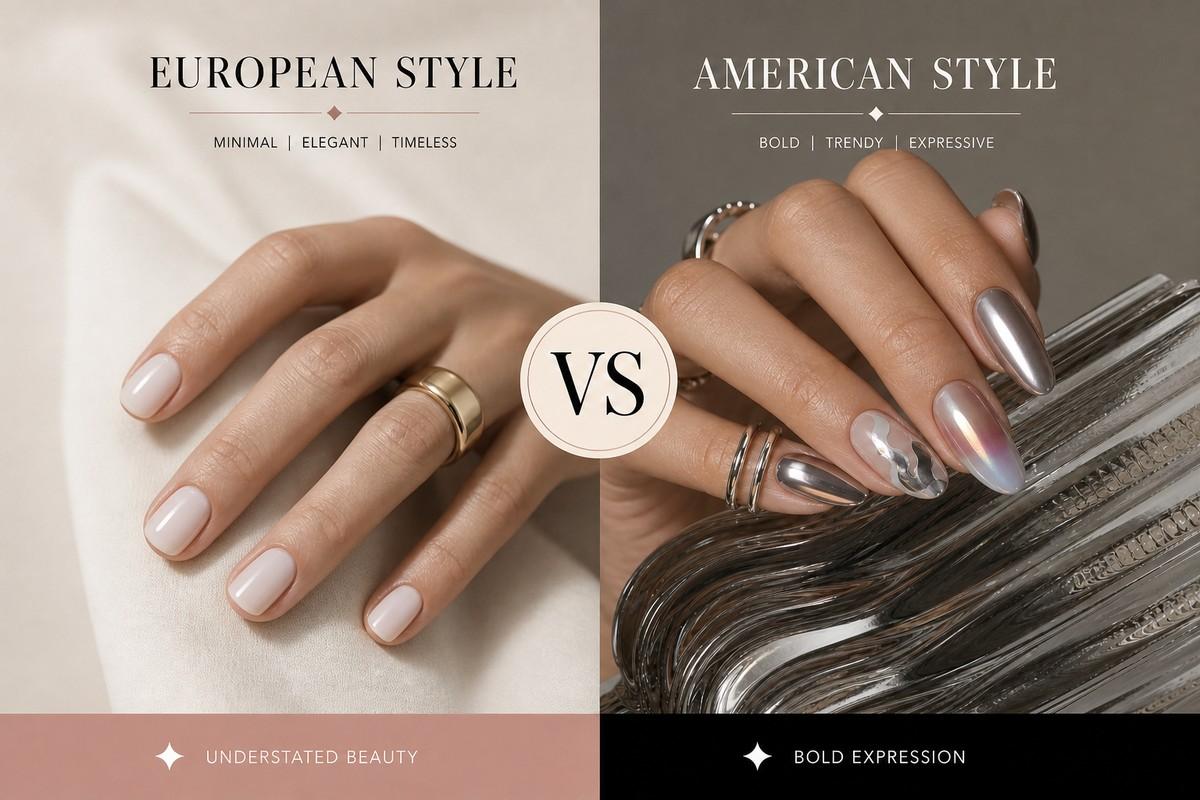
Currently, nail art that looks very natural and healthy is very popular in Europe, for example, milky white, sheer pink, soap nails ,clean nude, micro French. “Looks like naturally beautiful nails” is more popular than “obvious fake nails”.
By 2026, “Your Nails But Better” will have become one of the core keywords in the industry.
2. Short armor increased significantly
The US has historically favored longer nails, but the trend towards shorter nails is particularly noticeable in Europe, likely because European women place greater emphasis on:
√ Daily wear
√ Typing
√ Practicality
√ Office appropriateness
Short, square-shaped nails and short, almond-shaped nails grow very quickly.
3.Soft Gel replaces the traditional plastic feel
This is a major change in the industry. In the past, many supermarkets in Europe used thick, hard, and plastic-like gel, but in 2026, Ultra-thin soft gel is becoming a high-end trend.
European consumers are now increasingly concerned about:
√ Comfort
√ Natural curvature
√ Fits the nail shape like a natural nail
√ Reusable
√ No damage to nails
Therefore, a high-quality factory is very important, because low-end factories have difficulty making truly natural soft gel. European countries are also more fragmented; Europe is essentially a collection of national markets. Aesthetic tastes differ across countries, so a single brand image cannot be used to represent the entire EU.

4.TikTok Shop Europe is starting to impact the industry.
This is especially evident in the UK! Many European consumers are starting to adopt the “TikTok Discover → Amazon Purchase” model, which is becoming increasingly similar to the US approach.
5. The biggest hurdle in the European market: compliance
By 2026, Europe is increasingly resembling a “highly regulated beauty market” rather than a market for dumping cheap goods. especially:
1. REACH
2. TPO ban
3. HEMA Sensitive
4. Packaging regulations
5. Labeling regulations
The restrictions will only get stricter.
The industry has clearly begun to “eliminate factories with low document capabilities”.
⑧Is there a market for mid-to-high-end wearable nails in Europe?
To sum it up: the answer is yes, and Europe in 2026 is actually more suitable than the United States for “mid-to-high-end wearable press-on nail brands”.
一、Why does Europe now have an opportunity?
The European nail art market currently has a “gap.” There are already many low-end options, for example:
- Amazon low-priced goods
- Temu
- SHEIN
- Priced between 1 and 10 euros
This market segment is very competitive.
Currently, Europe doesn’t really have a brand that embodies the “professional, high-end wearable nail brand” that European and American consumers perceive. Unlike skincare with La Roche-Posay, makeup with Charlotte Tilbury, and perfume with Diptyque.
Europe hasn’t truly established a luxury press-on nail identity in the wearable nail industry, and that presents an opportunity.
二、European consumers are increasingly willing to buy “high-quality wearable nails”.
Because several trends are now overlapping.:
1. Salon fatigue
Salon manicures are expensive in many European countries, especially in France, the UK, Germany, and the Nordic countries. This is because labor costs are rising. Consumers are starting to think, “I just want my hands to look nice, I don’t want to spend 80-150 euros a month.”
Therefore, high-quality manicures are becoming more reasonable.
2.Clean Girl aesthetic is particularly suited to high-end nail art.
This is the key.
Previously, people were willing to spend 100 euros and sit for an hour at a salon for a manicure because super long nails or intricate rhinestone designs were all the rage. However, with changing aesthetics and a shift towards lower spending habits, a high-quality manicure experience can be obtained for less than a third of the price, and the design can be changed at any time, making it the best option.
3.European consumers are more willing to pay for “brand perception”.
Unlike in the US, European consumers tend to be more:
- aesthetics
- sustainability
- packaging
- philosophy
- ingredient story
- craftsmanship
Therefore, it is easier to build “long-term brands” in Europe.

4.The European press-on nail market may actually have better profit margins.
This is something many people don’t realize: competition in the US has become highly content-driven, and customer satisfaction (CAC) is increasingly high.
However, brand competition in Europe isn’t as mature as in the US, so it’s easier for you to:
- Building brand awareness
- Targeting high-priced items
- Repeat purchases
- Positioning as a premium brand
Especially Germany, France, and Northern Europe.
5.The truly worthwhile price range in Europe
I think the most dangerous price point is the low-price range, like €5-€10! It will be killed off by generic brands like Temu, Shein, and Amazon.
The best chance is in the €20-€40 range; consumers will start paying attention in this price range:
- brand
- package
- quality
- ingredient story
Instead of just comparing prices.
In short,in Europe in 2026, there is not only a market for mid-to-high-end wearable press-on nail, but it may also be in a “brand vacuum period.” The real opportunity lies not in selling large quantities of goods at low prices but in turning wearable press-on nail into a high-end beauty product, a clean luxury beauty item.
Whoever establishes “recognition as a high-end European wearable press-on nail brand” is likely to capture a long-term market share in the future.
We invite you to visit Senboma—the best press-on nail factory in China—to explore our collection of premium OEM/ODM press-on nail products and uncover the possibilities of beauty and innovation. Let’s embark on this journey together to explore the allure of nail art and express your unique style and charm!