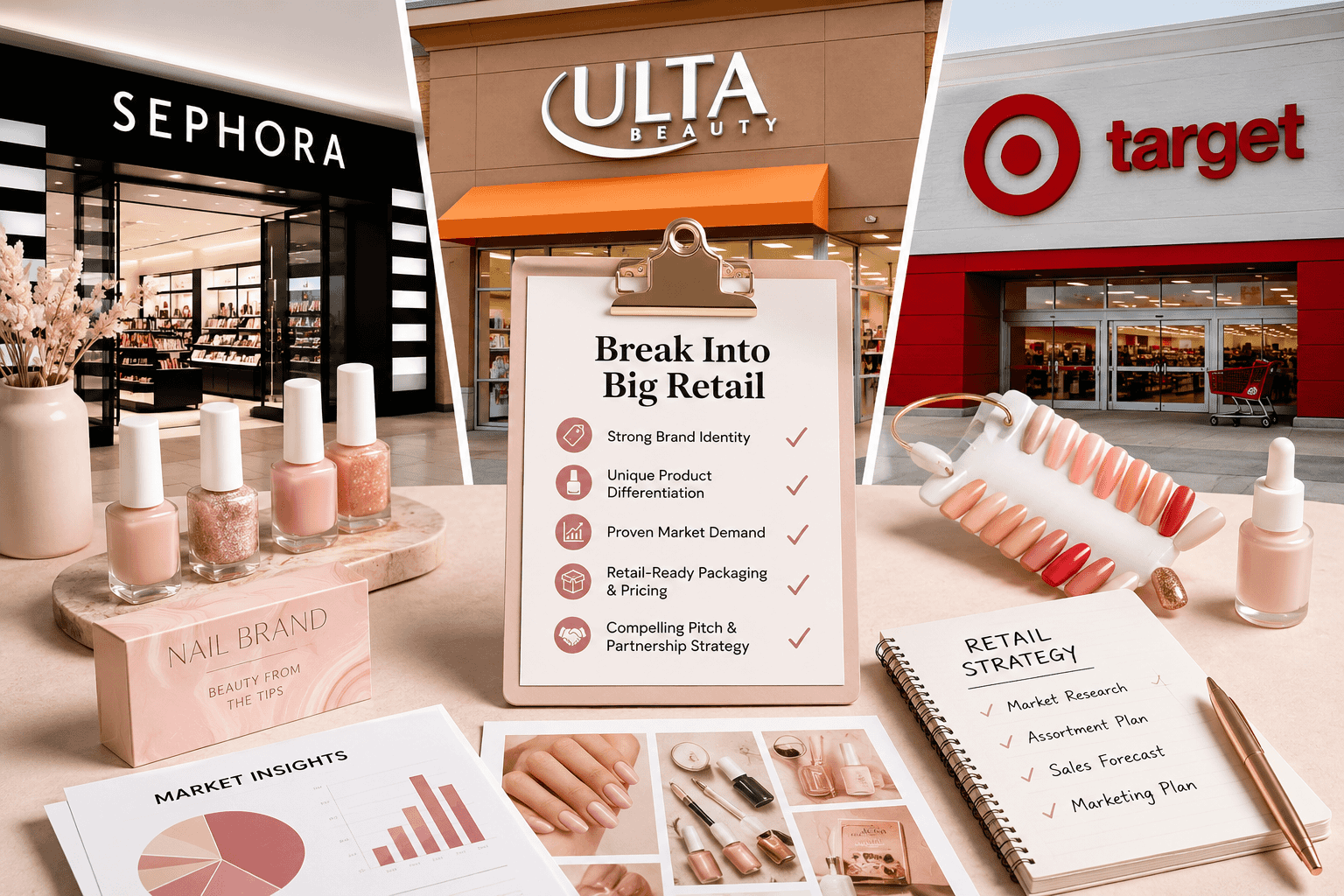
For a beauty brand that has only been established for a few years and is not yet considered a “big name,” the key to entering Sephora, Ulta Beauty, and Target is not “whether the scale is big enough,” but whether it can prove that the brands can sell, generate repeat purchases, drive traffic, and reduce the risk for retailers.
Retail buyers in Europe and America are increasingly fond of “new brands,” but only if these brands have already proven themselves in a specific niche market.
Take gel nail polish as an example:

1. Understand that the three channels are fundamentally different.
Sephora: Essentially a high-end trendsetter; it favors strong brand identity, compelling content, and unique positioning. Suitable for brands already possessing a certain level of brand awareness and growth momentum.
Ulta: Essentially a hybrid of mass-market and specialized; it prefers brands capable of rapid volume growth and a clear price range, suitable for brands in their growth phase.
Target: Essentially mass-market retail; it favors stable SKUs, a mature supply chain, and scalability, suitable for brands with proven products and strong supply chains. It is also the most difficult of the three channels to enter.
Many brands mistakenly believe that “good products guarantee entry,” but this is not the case.
The biggest fears for European and American retailers are: products failing to sell, lack of buzz on TikTok, stockouts, high return rates, packaging that doesn’t fit the shelf appeal, and a lack of marketing support.
2. The true entry path for new brands
Most truly successful new brands don’t simply “submit their resumes,” but rather:
DTC independent websites
↓ TikTok/Instagram seeding
↓ Amazon sales verification
↓ Boutiques/small chains
↓ RangeMe/ECRM/Cosmoprof
↓ Ulta/Target
↓ Sephora
Market validation comes first, then retail opportunity.
3. What do retail buyers really look for?
Is your brand positioning clearly stated in a single sentence?
Buyers review dozens of brands daily. You must articulate your brand’s positioning in one sentence. In European and American retail, the key elements are: strong market segmentation, a specific target audience, and a compelling shopping experience.
4. Brands must first have “pre-retail data”.
Without data, buyers are hesitant to take risks. For example:
TikTok views, UGC volume, DTC repeat purchases, Hero SKU percentage, and Amazon reviews.
5. The easiest way for a brands that has been established for several years to enter the market.
Start with “small regional retail,” don’t aim for Sephora nationwide or Target nationwide right away. That’s too difficult.
Start with these channels:
regional chain
boutique beauty stores
salon distributors
specialty retailers
Because large channels highly value “your offline experience.”
6. A truly effective platform
①RangeMe
This is one of the most frequently used platforms by US retail buyers.It includes platforms like Target, Ulta, CVS, Walgreens, and Kroger. Many buyers directly find new brands on this platform.
Brands can’t just “upload products”; their packaging images, retail prices, MSRPs, MOQs, social media data, sales data, and brand stories must all be professional.
② ECRM
This platform is more focused on genuine B2B sourcing connections. Many established brands meet with buyers here.
③ Cosmoprof North America
This is a crucial trade show for establishing relationships in the European and American beauty retail industry. Many new brands participate in the first year, then move into regional channels in the second, and finally join Ulta in the third—this is a common path.
7. The three things you should do right now
① Prepare your “Retail Ready-to-Go Kit”: Core SKUs, profit structure (retailers typically take a 50-60% margin), MOQ, and logistics capabilities.
② Build genuine social media endorsements: Buyers will definitely check your TikTok and Instagram before making a decision.
③ Find an industry broker (agent): Independent sales agents with Ulta/Sephora connections can help you accelerate your sales process, especially for new brands without connections.
8. If you are a nail salon/wearable nail brand, you should pay special attention.
Buyers in Europe and America are increasingly concerned about quality stability, adhesive safety, HEMA issues, cheap-looking packaging, and the short product lifecycle of TikTok.
Therefore, you must emphasize:
√ Factory capabilities (including ISO/GMP, CPSR, sustainable packaging, and FDA compliance). Having good factory support is crucial.
√ Product consistency (because retailers fear a good first batch followed by a defective second batch. This is a common problem with many low-end factories).
9. The best strategy in reality (very important)
If you’re a new brand that’s been around for a few years, don’t focus on getting into a major retailer unless your dad is the CEO.
Instead, focus on:
◎A truly viral Hero SKU.
◎A specific target audience, such as: Gen Z, office girls, salon alternatives, sensitive nails, or luxury reusable nails.
◎Dominate one social media platform; TikTok, Instagram, and Reels are currently the easiest.
◎Get buyers to “actively see you”: Many brands don’t succeed with cold emails, but rather with seeing you on TikTok, at trade shows, on RangeMe, or after being featured by KOLs. The success rate of others contacting you is far greater than you contacting them.
10. A key point that many brands overlook
Getting into the distribution channel doesn’t guarantee success. The real challenge is “disposal rate.”
American retail is extremely brutal. Many brands that don’t sell well within six months of being on the shelf are immediately removed. Therefore, what retail truly values isn’t “whether you can get in,” but “whether you can sell consistently.”
11. Analysis of the most typical brands that “rapidly entered mainstream retail within a few years”.
In recent years, nail products, especially nail salons, have been one of the most popular beauty categories on TikTok in European and American retail. Because they naturally attract impulse purchases with low average order values, spread through tutorials, offer the promise of “beauty in minutes,” and have strong visual appeal, including before/after photos.
Ⅰ. Glamnetic
This is one of the most classic examples of wearable nails that entered mainstream retail through social media explosion. It started as a magnetic eyelash brand, but the 2020 pandemic led to people staying home and getting manicures, and TikTok propelled its Press-on Nails to stardom.
2019 Brand Founded → 2020 Press-on nails became the core of growth → 2022 Entered Sephora and Ulta Beauty → Subsequent expansion to Target and Walmart

Ⅱ. Static Nails
A slower but stronger brand strategy.
2015 Brand Founded → Initially focused on DTC → 2018 Instagram/TikTok promotion → 2020 Entered some high-end retail → Subsequent expansion to Target
Ⅲ. Olive & June
This brand was actually founded earlier than many people realize. It wasn’t a “super-fast launch,” but it’s a classic example of how TikTok allowed a niche brand to suddenly enter national retail.
Established in 2013 → Initially focused on salon stores and DTC (Direct-to-Consumer) → Exploded growth during the 2020 pandemic → Large-scale entry into Target in 2021 → Subsequent expansion to CVS/Walmart, etc.
You’ll notice a key pattern:
Traditional Era: Establish a brand → Endure 5-10 years → Gradually enter retail
TikTok Era: Establish a brand → Content goes viral → DTC sales explode → Retailers actively seek you out
Therefore, many brands can now enter major channels within 2-4 years, which was almost impossible before.
12. Why are many Western brands hampered by “factory capacity”?
The biggest problem brought by TikTok is that a single video might get 10 million views and sell out within 48 hours, suddenly requiring restocking. At this point, ordinary factories will experience delays, color discrepancies, quality control failures, packaging errors, unstable adhesives, and a decline in the quality of the second batch. Retailers fear this most.
Because if you run out of stock at Ulta/Target, you might be immediately removed from the market.
13. What can a truly capable factory do for a brand?
Rapid trend development, such as the sudden popularity of TikTok:
Soap nails
Blueberry milk nails
Glazed donut nails
Soft gel
Excellent factories will proactively:
Recommend colors
Develop in advance
Provide samples
Provide existing inventory
Instead of simply saying “Please provide the Pantone color number,” the difference is significant.
14. With so many factories to choose from, why choose to partner with Senboma?
Brand Endorsement: Senboma collaborates with renowned international brands, including major retailers, primarily in Europe and America, giving us an understanding of their trends and popular styles.
Advanced Technology: Proprietary nano-level adhesive technology and a 72-hour waterproof test.
Exquisite Creativity: Over 1000 designs created annually by more than 20 international artists.
Quality Assurance: FDA and SGS certified, meticulously crafted, with a thickness of 0.3 mm.
Sustainability Leader: Utilizing plant-based resin materials for carbon-neutral production.
For over a decade, we have defined industry standards, perfectly blending exquisite craftsmanship with cutting-edge research and development. From red carpet collections to everyday essentials, our nail art stickers transform nails into wearable works of art.
We cordially invite you to visit Senboma—China’s leading press-on nails factory—or email nicole@gzsenboma.com for more information. Explore our extensive high-end OEM/ODM press on nails product line and discover the infinite possibilities of beauty and innovation. Let’s embark on this nail art journey together, experiencing the charm of nail art and showcasing your unique style and flair!